Pilih jalurmu
Lebih spesifik
Have you ever wondered why telling your friends about your weekend trip sounds completely different from reading a fairy tale or describing your new pet? Today we will sort them out.
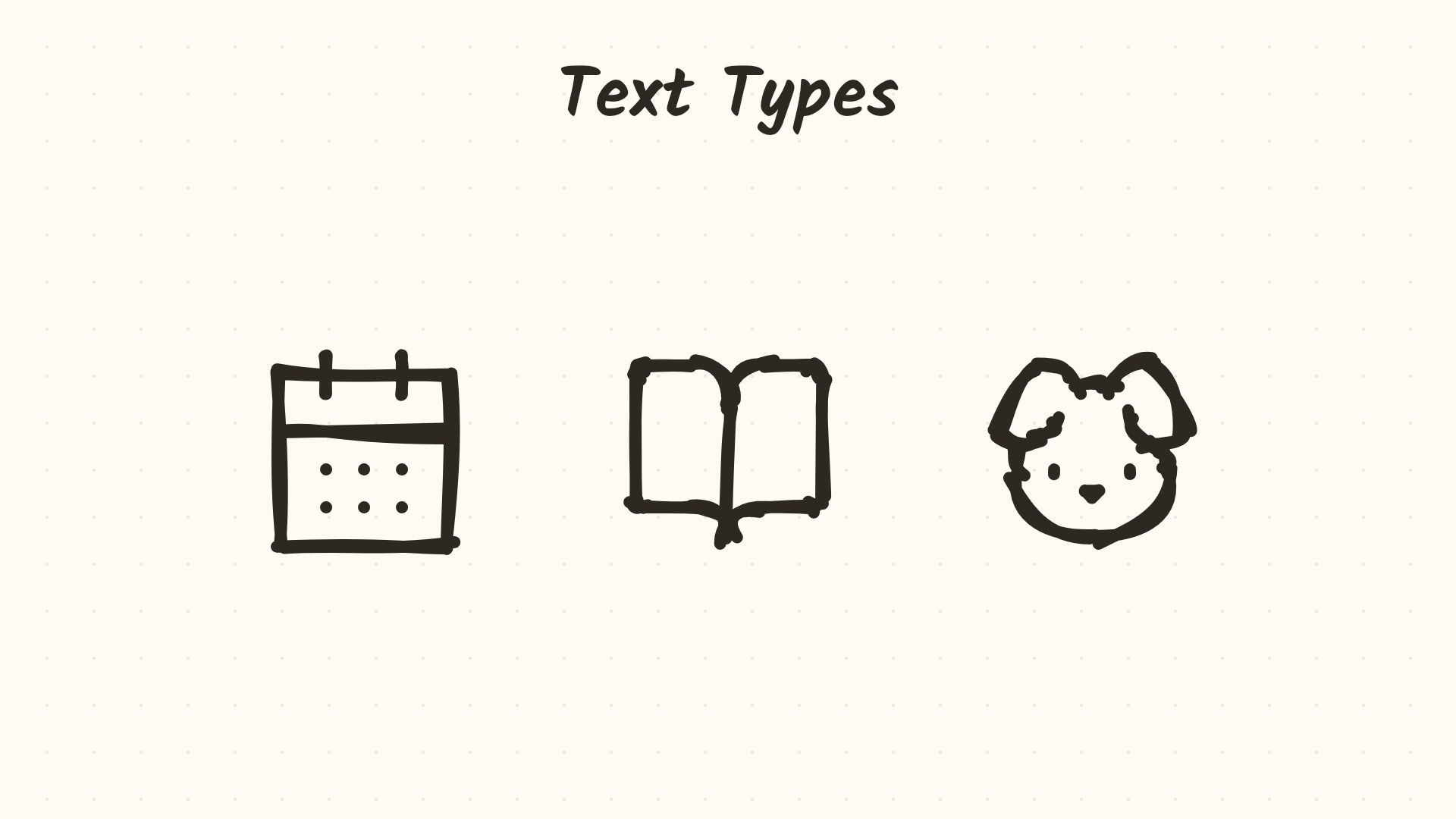
Let's start by describing your dog. Look at Buster here. He has thick brown fur, sharp teeth, and he always sleeps on my shoes.
Notice how we use the Simple Present Tense for facts. The structure is simple: first, the Identification where we introduce Buster, followed by the Description of his physical features and habits.
Now, what if we retell a past event? Yesterday, I took Buster to the park. First, we played fetch. Then, it rained, so we ran home.
Because this already happened, we use the Simple Past Tense. We start with an Orientation setting the scene, list the Events in chronological order, and end with a Reorientation.
Here is a common trap: thinking any past event is a Narrative. That is wrong! Recounts just list what happened. They have no major conflict or problem to solve.
To make it a Narrative, we need a conflict. Once upon a time, Buster got lost in a dark forest. A giant wolf attacked him, but he cleverly escaped!
This story also uses Past Tense, but the structure changes. After the Orientation, we hit a Complication, which is the big problem, and finally a Resolution where the hero escapes.
To sum up: you describe your pet's fur with Descriptive text, recount your weekend trip with Recount text, and read a story about overcoming a monster using Narrative text.